|
|
|
 |
|
Catcher Technology Co., LTD.
Risk Management Policies, Procedures, and Implementation in the Current Year
|
|
Risk Management Policy and Procedures
|
|
To promote sustainable operations, strengthen corporate governance, and enhance the risk management framework, the Board of Directors of Catcher Technology approved the adoption of the “Risk Management Policy and Procedures” on November 6, 2024, with the Audit Committee overseeing risk management matters. To further strengthen risk management and sustainability governance, the Company established the Sustainability Development and Risk Management Committee under the Board of Directors on November 6, 2025. The Committee is responsible for overseeing risk management–related matters, while the Sustainability Development Office coordinates and consolidates risk issues and implements risk management activities. The Sustainability Development Office reports at least annually to the Sustainability Development and Risk Management Committee and the Board on the operation and outcomes of the Company’s risk management framework.
The Company’s risk management framework covers environmental risks (including climate change, biodiversity, occupational health and safety, and energy management), social and human rights risks, corporate governance risks (including legal and regulatory compliance, anti-corruption and fraud prevention, and information security), financial risks, and other operational risks. The risk management process encompasses key stages such as risk identification and analysis, risk assessment, risk response, and monitoring and review mechanisms. Relevant departments regularly identify risk items based on their operational responsibilities and, in accordance with materiality principles and stakeholder concerns, conduct risk identification and analysis to assess the potential impact of each risk on the Company’s operations. Based on these assessments, appropriate risk management measures and mitigation strategies are formulated to enhance operational resilience.
|
Risk Management Organization and Responsibilities
|
|
| Level |
Responsibilities |
| First line of defense |
Each business or management unit is responsible for implementing risk identification, assessment, monitoring, and response measures in accordance with the Risk Management Policies and Procedures as part of daily operations and management activities. |
| Second line of defense |
The Internal Audit Department conducts regular audits and reviews to evaluate the adequacy and effectiveness of each unit’s risk management systems and implementation. Improvement recommendations are provided to ensure the continuous effectiveness of risk control. |
| Third line of defense |
The Sustainability Development Office, under the supervision of the Chairman, is responsible for coordinating overall risk management, consolidating implementation results from various units, and regularly reporting to the Sustainability Development and Risk Management Committee and the Board of Directors to ensure the ongoing enhancement of the Company’s risk management framework. |
|
Overview of Risk Management Operations |
Catcher actively implements its risk management system and continuously strengthens the identification, assessment, and control of various risks. On November 6, 2025, the Sustainability Development Office presented the annual report on the Company’s risk management operations to the Audit Committee and the Board of Directors. The key highlights are summarized as follows:
|
1. Identification, Analysis and Assessment of Key Risk Issues
|
| Steps of Analysis |
Description |
| Understanding Organizational Path |
| • |
Stakeholder Identificatio |
| Catcher has identified its key stakeholders as employees, customers, suppliers, investors and shareholders, community residents, government agencies, non-profit/non-governmental organizations, and the media. |
| • |
Identification of Sustainability and Risk Issues |
| Drawing primarily on the GRI Standards, and referencing the SASB industry standards, TCFD climate-related financial disclosures, RBA Code of Conduct, UN Global Compact, and SBTi framework, Catcher compiled a comprehensive set of sustainability and risk issues. These issues reflect both Catcher’s operational impact on the economy, environment, and society, as well as factors influencing stakeholder evaluation and decision-making. The Sustainability Development Office initially consolidated 72 issues relevant to the industry, which were subsequently integrated into 17 material topics through sustainability meetings and impact assessments. |
|
| Identifying Actual and Potential Impacts |
| • |
Stakeholder Identification and Assessment |
| Each year, Catcher conducts a stakeholder questionnaire survey to evaluate the impacts of its operational activities, industry type, and value chain. The survey serves as a key communication channel to understand stakeholder concerns regarding various sustainability and risk issues. Concern levels are scored on a scale of 1 (not concerned) to 5 (very concerned), enabling the identification of the significance of each issue. In the most recent survey, 196 valid responses were collected. |
| • |
Internal Identification and Assessment |
| Through sustainability meetings, Catcher evaluates the actual, potential, positive, and negative impacts of each sustainability and risk issue. The assessment includes determining the likelihood of occurrence for stakeholders, the probability of actual and potential occurrence (scored on a scale of 1 to 5), and the potential benefits of positive impacts as well as the severity of negative impacts on operations, also scored from 1 to 5. |
|
| Assessing Significance of Impacts |
| • |
Sustainability and risk issues are prioritized based on their average weighted total scores, which combine the level of stakeholder concern with the degree of the Company’s operational impact. Issues achieving a score of 3.3 or higher, as determined through sustainability committee meetings, are classified as significant sustainability and risk issues. |
| • |
Biodiversity” and “Local Care and Social Inclusion” were assessed as low-significance issues in 2023 and therefore were not included in the scope of material sustainability and risk issues in 2024 and 2025. Nonetheless, Catcher continues to disclose relevant information on these topics to ensure transparency and accountability. |
|
| Reporting Significant Impact Issues |
| • |
Through sustainability committee meetings, Catcher identified 15 significant issues for the current reporting period. These issues are aligned with the material topics defined by the GRI Standards and serve as the foundation for disclosures in the Company’s Sustainability Report. Stakeholder engagement and feedback are continuously facilitated through Catcher’s official website and its Sustainability Report. |
|
|
2. Results of the Identification of Significant Impact Issues
(A total of 15 significant issues were identified during the current reporting period)
|

|
Weighted Quantitative Scoring of Significant Impact Issues for the Current Period
|
| E (Environmental Risk Issues) |
S (Social Risk Issues) |
G (Corporate Governance Risk Issues) |
|
Energy Management
|
3.86
|
Occupational Safety & Health
|
3.94
|
Risk Management
|
4.07
|
|
Climate Change Risks/Opportunities & Environmental Management
|
3.76
|
Talent Attraction, Employee Benefits, Training & Development
|
3.82
|
Product Innovation & R&D
|
3.92
|
|
Circular Economy & Greenhouse Gas
|
3.73
|
Labor-Management Relations & Human Rights Protection
|
3.68
|
Integrity & Pragmatism
|
3.69
|
|
Air Pollution
|
3.73
|
Local Care & Social Inclusion*
|
3.10
|
Supply Chain Management
|
3.49
|
|
Waste Management
|
3.66
|
|
|
Information Security & Privacy Management
|
3.46
|
|
Water Resource Management
|
3.62
|
|
|
Product Quality & Safety
|
3.37
|
|
Biodiversity*
|
2.49
|
|
|
|
|
*Biodiversity and Local Care and Social Inclusion were assessed as low-significance issues in 2023 and, therefore, were not included within the scope of material sustainability and risk issues in 2024 and 2025. Nonetheless, Catcher continues to disclose relevant information on these topics to ensure transparency and demonstrate its ongoing commitment to environmental protection and community engagement.
|
Risk Management Operations
For each major risk issue, Catcher has established corresponding risk management mechanisms, procedures, and regulations. To date, no significant irregularities or major incidents have occurred, and all risk mitigation measures have been effectively implemented and monitored, demonstrating Catcher’s commitment to proactive risk control and operational resilience.
|
| Type of Risk |
Identification and Analysis |
Designated Department |
Status of Risk Mitigation Initiatives |
| Environmental Risks |
Climate Change |
Business Management Department |
| • |
Catcher follows the Task Force on Climate-related Financial Disclosures (TCFD) framework to systematically assess potential physical risks, transition risks, and climate-related opportunities that may affect its operations. Based on these assessments, the Company designs and implements corresponding mitigation and adaptation strategies and integrates them into overall business operations and management processes. |
| • |
Implementation Status: Catcher conducts a comprehensive assessment of the likelihood of occurrence, severity of impact, and the potential influence of climate-related issues on its short-, medium-, and long-term operations. Significant climate risks and opportunities are identified and reviewed through the Sustainability Committee meetings. The evaluation results for 2025 are summarized as follows: |
| □ |
Significant Transition and Physical Risks: A total of 8 risk items were identified — 0 high, 0 medium-high, 3 medium, 2 low, and 3 very low. |
| □ |
Climate Opportunities: A total of 4 opportunity items were identified — 0 high, 2 medium-high, 0 medium, 2 low, and 0 very low. |
|
| Circular Economy,Greenhouse Gas and Energy |
R&D Division,Engineering Department |
| • |
In alignment with the international Greenhouse Gas (GHG) Protocol standards, Catcher establishes its emission reduction targets in accordance with the Science Based Targets initiative (SBTi) and implements comprehensive energy management under the ISO 50001 Energy Management System, ensuring systematic control and continuous improvement of energy performance. |
| • |
Implementation Status |
| □ |
2024: The Group’s Scope 1 (direct) and Scope 2 (indirect) greenhouse gas emissions totaled 211,086.16 tCO₂e, representing a 28.65% reduction compared with the 2022 baseline year. Scope 3 (other indirect) emissions amounted to 180,993.86 tCO₂e, a 33.87% decrease from the 2022 baseline. Both results successfully met the interim reduction targets established under the SBTi framework. In addition, the annual electricity savings rate across all Taiwan production sites exceeded 1%. |
| □ |
2025: In line with the interim carbon reduction targets set under the SBTi, the Group will continue to implement diverse carbon reduction and energy-saving programs to ensure steady progress toward its annual reduction objectives. |
|
| Air Pollution, Waste and Water Resource Management |
Occupational Safety Office |
| • |
Catcher has obtained ISO 14001 Environmental Management System certification, valid through September 2027, reinforcing the Company’s commitment to continuous improvement in environmental management. |
| • |
Implementation Status: As of 2024 and 2025 to date, no abnormal events or non-conformities have been recorded. |
|
| Fire Risk Management |
Occupational Safety Office |
| • |
Catcher manages fire safety in compliance with local regulations and internal procedures, ensuring complete fire protection equipment and effective emergency response mechanisms to minimize fire risks and protect personnel and property. |
| • |
Implementation Status |
| □ |
2024: Two fire incidents occurred, with no casualties. Catcher immediately notified local fire authorities for prompt response and containment, resolving both incidents quickly without disrupting production. The Company subsequently implemented corrective and preventive measures, reinforced chemical management and fire drill procedures, and enhanced employee training and safety awareness on chemical storage to prevent recurrence. |
| □ |
2025: No abnormal events have occurred to date. |
|
| Social and Human Rights Risks |
Labor Relations and Human Rights Protection |
Human Resource Division |
| •
|
In accordance with the Responsible Business Alliance (RBA) Code of Conduct, Catcher conducts annual human rights due diligence to identify and assess potential risks, implement mitigation measures, continuously improve management processes, and provide employee education and training to strengthen awareness and compliance. |
| •
|
Implementation Status: As of 2024 and 2025 to date, no human rights violations have been identified or reported. |
|
| Talent Attraction and Retention |
Human Resource Division |
| • |
Catcher has obtained certification under the Talent Quality-management System (TTQS) and continues to advance employee development through diversified training and education programs. |
| □ |
Internal Training: Enhances employees’ core and professional competencies through on-the-job training, work instruction, and job rotation. Key initiatives include pre-employment orientation for new hires, managerial skill development for supervisors, professional competency enhancement, internal instructor certification, general education courses, AI English practical camps, and projects on programming and automation technologies. |
| □ |
External Training: Provides employees with opportunities to participate in professional seminars and advanced courses conducted in collaboration with leading domestic and international universities and training institutions. These programs are designed to enhance employees’ technical expertise, broaden professional perspectives, and strengthen competitiveness in emerging industries. |
| □ |
Industry–Academia Collaboration: Supports the Taiwan Society of Precision Engineering in organizing the “2024 Precision Engineering Topics and Paper Awards” to foster an innovation-driven research culture and promote collaboration among industry, academia, and research sectors. |
| □ |
Management Succession: Implements succession planning for key management positions to ensure leadership continuity and sustainable organizational development. |
| • |
Implementation Status |
| □ |
2024: Total training hours across the Group reached 713,659.3 hours. |
| □ |
2025: All Group production sites continue to execute annual education and training programs. |
|
| Occupational Safety and Health |
Occupational Safety Office |
| • |
Catcher conducts stakeholder analysis in accordance with the ISO 45001 Occupational Health and Safety Management System and relevant local environmental, health, and safety regulations to ensure full compliance. Beyond meeting statutory requirements, the Company continuously implements improvement measures to enhance occupational safety performance and exceed regulatory standards. |
| • |
Implementation Status |
| □ |
2024: The Group recorded 42 occupational accidents, involving 42 employees, accounting for approximately 0.28% of the total workforce. To strengthen workplace safety, Catcher conducts regular hazard identification and risk assessments and continuously enhances preventive measures, including separating machinery and personnel work areas, providing improved personal protective equipment, enhancing hazard signage, and updating safe work procedures. |
| □ |
2025: To date, the Group has experienced no abnormal or major occupational accidents. |
|
| Governance Risks |
Compliance |
Legal Affairs Office |
| • |
Compliance analyses are conducted in accordance with applicable environmental laws and regulations to verify conformity and ensure that appropriate corrective or preventive measures are implemented as needed. |
| • |
Implementation Status: In 2024 and to date in 2025, Catcher has not received any fines or penalties from regulatory authorities for major violations of environmental laws or regulations. [Note] |
|
| Corruption and Fraud |
Legal Affairs Office |
| • |
Management is implemented in accordance with the Integrity Management Policy approved by the Board of Directors. |
| • |
Implementation Status: As of 2024 and 2025 to date, neither Catcher nor its subsidiaries have made any political donations. The Company has not been involved in any legal proceedings related to anti-competition, antitrust, or monopolistic practices, nor has it incurred any penalties, fines, or sanctions for corruption, fraud, accounting misconduct, or other violations of laws governing ethical business conduct. |
|
| Information Security and Personal Data Protection |
Information Technology Department |
| • |
Catcher has obtained ISO 27001 Information Security Management System certification and established comprehensive personal data protection procedures. The Company has implemented necessary information security controls and monitoring mechanisms to enhance cybersecurity resilience and prevent data leakage involving both customer and Company information. |
| • |
Implementation Status: As of 2024 and 2025 to date, no cybersecurity breaches or personal data leakage incidents have occurred. |
|
| Financial Risks |
Market Risks Credit Risks Liquidity Risks |
Finance Division |
| •
|
In accordance with the internal Financial Risk Management Policy, Catcher analyzes relevant exposures based on the nature, level, and scope of risk, and prepares regular risk assessment reports to effectively monitor and manage financial risks across the Group. |
| •
|
Implementation Status: As of 2024 and 2025 to date, no abnormal financial events have occurred. For additional details, please refer to Catcher’s quarterly financial reports. |
|
| Other Operational Risks |
Market Risk |
Sales & Marketing Division |
| • |
Catcher actively diversifies its business portfolio across multiple sectors—including electronics, healthcare, semiconductors, and aerospace—to mitigate the impact of fluctuations in any single industry. The Company also enhances communication with customers and assembly partners to optimize supply chain and production strategies. |
| • |
Implementation Status: No abnormal events were reported in 2024 or to date in 2025. Each business unit continuously monitors industry and market trends, conducts regular risk analyses, and implements appropriate management measures to effectively mitigate potential market risks. |
|
| Supply Chain Risks |
Supply Chain Management Department |
| • |
Management is conducted in accordance with the Company’s Supplier Management Policies, Corporate Social Responsibility (CSR) standards, Catcher’s CSR requirements, regulations on restricted hazardous substances, and the Conflict-Free Minerals Declaration. Catcher closely monitors potential supply chain disruptions or shortages, actively evaluates market conditions for key raw materials and critical components, and maintains relationships with at least two qualified suppliers to mitigate the risk of supply interruptions. |
| • |
Implementation Status: As of 2024 and 2025 to date, no suppliers have been found in violation of relevant regulations resulting in contract termination or order cancellation, and no major material shortages have occurred. |
|
| Product Innovation and R&D Risks |
R&D Division |
| •
|
Management is conducted in accordance with the Intellectual Property Management Procedure. |
| •
|
Implementation Status: As of 2024 and 2025 to date, no incidents of infringement on competitors’ technical or intellectual property rights have occurred. |
|
| Product Safety Risks |
Quality Assurance Division |
| • |
In compliance with applicable laws, regulations, and customer requirements, Catcher conducts comprehensive product inspections and testing to ensure product safety and reliability. |
| • |
Catcher has obtained AS9100 Aerospace Product Quality Management System and ISO 13485 Medical Device Quality Management System certifications, as well as the Taiwan Ministry of Health and Welfare Medical Device Manufacturer Quality Management System (QMS) certification, establishing a comprehensive product safety and quality management framework. |
| • |
For environmentally regulated substances (e.g., EU RoHS and REACH), the Company enforces strict controls under internal management procedures to ensure all materials and processes comply with international standards and customer environmental requirements. |
| • |
Implementation Status: As of 2024 and 2025 to date, no incidents of non-compliance related to product safety or hazardous substance management have been recorded. |
|
| Product Quality Risks |
Quality Assurance Division |
| • |
Catcher has obtained ISO 9001 Quality Management System, AS9100 Aerospace Product Quality Management System, and ISO 13485 Medical Device Quality Management System certifications, establishing a comprehensive and standardized quality management framework. |
| • |
The Company continuously strengthens quality management training and encourages employees to obtain professional quality certifications, enhancing organizational quality capabilities, execution efficiency, and overall product quality stability to further increase customer satisfaction. |
| • |
Implementation Status: As of 2024 and 2025 to date, no major customer complaints have been reported. Catcher has established a product information traceability system to monitor the entire manufacturing process, effectively control high-risk materials, and prevent defective products from reaching customers. In addition, through the Corrective and Preventive Action (CAPA) quality improvement mechanism, the Company continuously implements corrective and preventive measures to enhance quality management performance and mitigate potential risks. |
|
Note: Under the Taiwan Stock Exchange Corporation’s Procedures for Verification and Public Disclosure of Material Information by Listed Companies, any single event with cumulative fines of NT$1,000,000 or more is classified as a material event.
|
Information Security Risk Management Framework
|
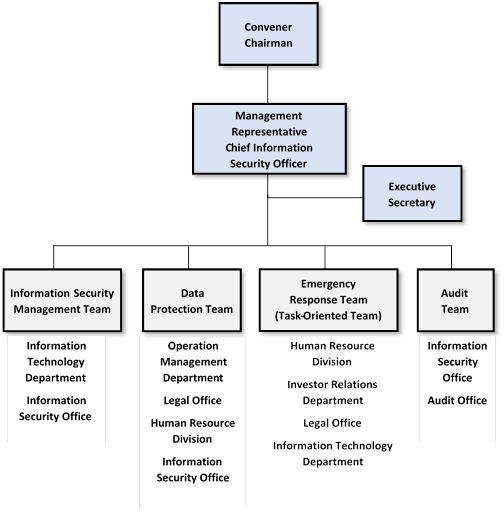
Catcher Technology has established an Information Security Promotion Task Force, comprising a Convener, Management Representative, Executive Secretary, Information Security Management Team, Data Protection Team, Emergency Response Team (task-oriented), and Audit Team. The Task Force is responsible for formulating the directions and strategies for the Company’s information security development, and for promoting and implementing the initiatives related to information security management to ensure the continuous and stable operation of the information security management system.
| • |
Information Security Promotion Task Force: The Company’s decision-making and management body for information security, responsible for overseeing and coordinating information security initiatives. |
| • |
Management Representative: Responsible for the overall planning of information security–related systems, coordination of resources, and implementation of related projects.
|
| • |
Executive Secretary: Assists the Management Representative and the Convener in carrying out information security management duties.
|
| • |
Information Security Management Team: Responsible for the planning, establishment, implementation, maintenance, review, and continual improvement of the Company’s information security management system; reports information security–related matters to the Information Security Promotion Task Force; coordinates and confirms audit schedules; oversees audit execution; and supervises preventive and corrective actions. |
| • |
Data Protection Team: Responsible for promoting and implementing management systems for data and personal data protection.
|
| • |
Emergency Response Team: A task-oriented team responsible for monitoring and tracking the development of major information security incidents, and for maintaining, updating, and executing disaster recovery procedures. |
| • |
Audit Team: Responsible for formulating information security–related audit plans, conducting audits, and tracking preventive and corrective actions for any nonconformities identified during audits. |
|
Information Security Policy
|
|
|
|
Catcher Technology is committed to information security management. Through comprehensive management systems and technical controls, the Company safeguards its products, services and information assets, prevents unauthorized access, alteration, use and disclosure, and mitigates potential losses arising from natural disasters and other unforeseen incidents. The Company ensures the timeliness, integrity and availability of information to protect the confidentiality, integrity and availability of critical information assets, while complying with applicable laws and regulations. These efforts are aimed at strengthening customer trust, fulfilling commitments to shareholders, and ensuring the continuity of critical operations and the Company’s sustainable development.
| • |
Organization-wide participation to enhance information security awareness: Foster a culture in which information security is everyone’s responsibility through full participation and continuous education and training. |
| • |
Proactive prevention and effective information security management: Establish robust information security protection technologies, implement an information security management system, and continuously review and enhance management effectiveness through the Plan–Do–Check–Act (PDCA) cycle. |
| • |
Customer trust and sustainable operations: Provide a secure, stable, and trusted operating and manufacturing environment to ensure the Company’s long-term, steady business development. |
|
Information Security Management Program
|
|
|
|
To demonstrate the Company’s commitment to information security management and to ensure that all information assets and systems are appropriately protected, the Company has established, documented, implemented and maintained an Information Security Management System (ISMS) in accordance with ISO/IEC 27001:2022. Through continual improvement mechanisms, the Company continuously enhances the effectiveness of the system’s operation.
Objectives
| • |
Implement appropriate protection and security measures for all information stored, processed, or transmitted by the Company. |
| • |
Reduce the likelihood and impact of information security incidents involving damage, theft, leakage, tampering, misuse, or infringement of information assets. |
| • |
Continuously strengthen the confidentiality, integrity, and availability of information services and systems across all operational processes. |
|
Information Security Management Measures
|
|
|
|
In accordance with ISO/IEC 27001:2022, Catcher Technology adopts the Plan–Do–Check–Act (PDCA) cycle to establish and implement its Information Security Management System, ensuring effective operation and continual improvement.
| • |
Establish a comprehensive information security governance structure responsible for promoting information security policies, facilitating cross-departmental coordination, and overseeing implementation. |
| • |
Conduct management reviews at least annually to ensure the appropriateness, adequacy, and effectiveness of the ISMS; review items including improvement initiatives, significant requirements, and assessments of the impact of material changes in the operating environment. |
| • |
Define and continuously monitor key performance indicators (KPIs) for information security to evaluate performance and the overall effectiveness of the ISMS. |
| • |
Perform information security assessments and audits on a regular basis or as needed to verify compliance with legal requirements and information security standards for control objectives, measures, and operating procedures; implement corrective actions and ongoing maintenance in accordance with plans to continuously enhance the maturity and effectiveness of the ISMS. |
|
Achievements of Information Security Management
|
|
|
|
| Strengthening the Information Security Management System |
Enhancing Information Security Defense Drills |
Enhancing Employees’ Awareness of Information Security |
| •
|
Catcher Technology has obtained external certification for its ISO/IEC 27001:2022 Information Security Management System (ISMS), valid from October 18, 2025 to October 18, 2028. The Company and its overseas subsidiaries have established and implemented the ISMS in accordance with ISO/IEC 27001:2022, adopting the Plan–Do–Check–Act (PDCA) cycle to ensure certification validity and continuously enhance information security management effectiveness.
|
| •
|
In 2025, a total of 12 information security management–related meetings were convened to strengthen governance communication and cross-departmental collaboration.
|
| •
|
In line with existing operating procedures and ISMS requirements, 18 related policies and procedural documents were revised during 2025.
|
| •
|
Management and technical controls for data protection were continuously strengthened to enhance the overall level of information security protection.
|
| •
|
In 2025, a total of 10 personal data protection procedural documents were developed and issued, covering consent for the collection, processing, and use of personal data, personal data inventory review, physical security inspections, and risk assessments, thereby reinforcing personal data protection and ensuring compliance with the Personal Data Protection Act.
|
| •
|
Information security audits were conducted on key information service providers and suppliers involved in personal data processing, in accordance with existing operating procedures, to mitigate supply chain information security risks.
|
|
| •
|
In 2025, a total of 11 operational drills for critical information systems were completed, continuously strengthening system stability and business continuity and resilience.
|
| •
|
Two information security incident notification drills were conducted in 2025 to enhance cross-departmental incident response and reporting effectiveness.
|
| •
|
System vulnerability scanning and information security risk assessments were carried out on a regular basis, totaling 28 times during the year, with a 100% completion rate for corrective actions addressing high-risk items.
|
|
| •
|
Based on risk assessment results and current events, a total of 30 information security awareness materials were produced and disseminated to employees, continuously communicating key information security policies and reminders; cumulative internal outreach exceeded 60,000 instances in 2025.
|
| •
|
The completion rate for general information security awareness training reached 100%, with all employees (more than 2,500 staff members) completing annual information security and data protection training.
|
| •
|
The completion rate for general personal data protection training also reached 100%, further strengthening employees’ awareness of personal data protection and compliance responsibilities.
|
| •
|
Six social engineering simulation exercises were conducted in 2025, with an average click-through rate of less than 0.2% for the year, demonstrating a significant improvement in employees’ information security risk awareness and prevention capabilities.
|
|
|